
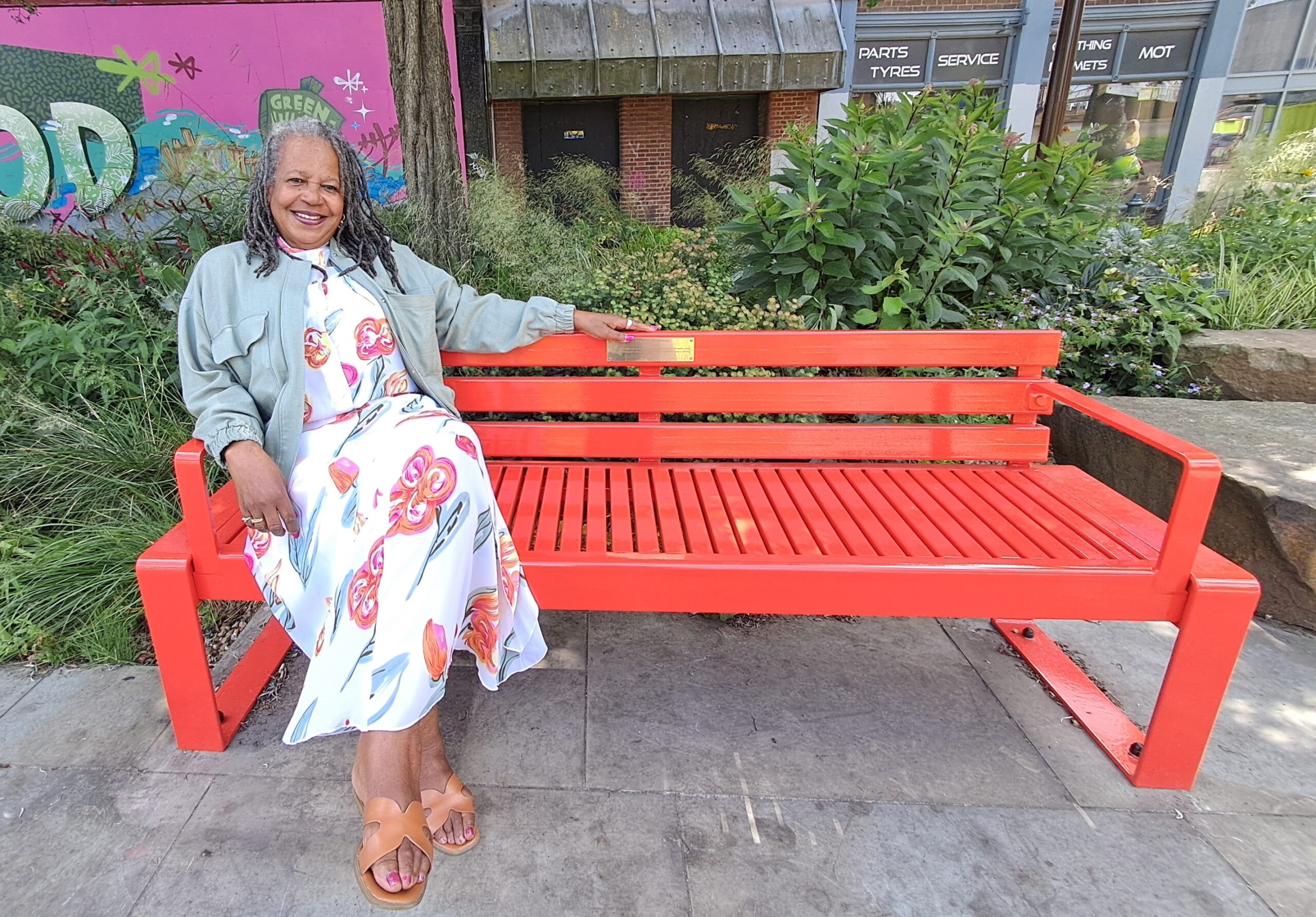
A grandmother-of-five has been honoured with an iconic red bench in Nottingham city centre to celebrate her recovery from heart surgery and raise awareness of the importance of research into cardiovascular disease.
City resident Bettina Wallace, aged 72, is one of just 65 people across the UK chosen by British Heart Foundation (BHF) to take part in its national campaign and have a red bench installed with their name on it, to celebrate 65 years of the charity funding life-saving cardiovascular research.
Behind every bench is a powerful real-life story of someone living with a cardiovascular condition and thanks to research, they can survive to enjoy life with their loved ones.
Bettina, a mother-of-three and grandmother-of-five, received the shock diagnosis of high blood pressure after collapsing on a train during her regular commute. Despite her family history putting her at risk – her grandmother, mother and father all had high blood pressure – she’d never previously been for a blood pressure check.
Then in 2024 Bettina underwent heart surgery to repair a leaking mitral valve, from which she has made a good recovery.
Bettina’s bench has been unveiled at the Green Heart overlooking the Standing In This Place statue, which Bettina was actively involved in the commissioning of.
BHF worked with Saatchi & Saatchi and Raw Research to identify cardiovascular disease survivors and suitable locations, with Bettina’s bench installed thanks to the work of Nottingham City Council.
Bettina has made changes to her diet and lifestyle and, through a BHF project, has embarked on a mission to educate others in her community about healthy eating.
Today, thanks to advances in research and treatment, Bettina lives a full and active life – and loves running around after her youngest grandchildren, aged four and eight.
She is determined to break the stigma surrounding heart disease and says she feels ‘honoured’ to be part of British Heart Foundation’s campaign.
Bettina said: “I feel privileged to be involved in this campaign. I am very keen that people see me as a black woman who isn’t afraid to talk openly about their health and share their experience.
“My eight-year-old granddaughter Fleur is so excited that Nana is going to have a bench with her name on it! This bench will be here when I’m no longer on earth, it will be my legacy – a talking point in Nottingham for the black community.
“To me, it’s bigger than getting an MBE or OBE because it’s a bench that everyone can see and ask questions about. We need the black community to talk about health and I hope this will spark more conversations about cardiovascular health.
“My diet was very high in salt and fat- but now I have an allotment, exercise and eat healthily.”
Councillor Neghat Khan, Leader of Nottingham City Council, said: “I’m delighted to see this colourful addition to our wonderful Green Heart and pleased to hear that Bettina is doing so well after heart surgery.
“The siting of her bench is also important because Bettina played a key role in the installation of the nearby Standing In This Place statue, which recognises the contribution of thousands of unnamed women who were the driving force behind the East Midlands cotton industry during Industrialisation.
“I know that the statue and its powerful message mean a great deal to Bettina and others that worked on the project, so we hope that she will be able to enjoy admiring the sculpture from the comfort of this new bench in her honour.”
Every three minutes, someone in the UK dies from cardiovascular disease, which affects more than eight million people nationwide.
However, a new survey commissioned by BHF of 2,000 UK adults living with cardiovascular disease has found that over half of people (55 per cent) said they have felt judged or embarrassed about their condition. And with cardiovascular disease able to affect anyone, three in four (73 per cent) agreed that people think it only affects certain demographics, such as older people.
Bettina said: “There is stigma and judgement attached but the more we get people talking about heart conditions the less stigma there will be. Lots of members of the black community are reluctant to talk about health but we need to get involved in research.
“I want to challenge the taboo, I want my grandchildren to know I experienced heart conditions and that I wasn’t afraid to speak about them. As an individual, I feel I have a duty to speak about my health. Cardiovascular disease doesn’t just affect one demographic or ethnicity – it can affect all of us – but as an African Caribbean I am more prone to cardiovascular disease, so I’m passionate about rising awareness.
“Life is whizzing by. You have to grasp every opportunity to live an impactful life. I want to inspire my grandchildren.”
British Heart Foundation hopes that the red benches will encourage others to open up about their experience of living with cardiovascular disease and help raise awareness across the UK.
The charity is also urging people for donations so they can help fund more groundbreaking research to keep the nation’s hearts beating.
Lifesaving research funded by BHF includes its flagship CureHeart programme, which could one day find new treatments and cures for inherited heart muscle diseases. BHF is also funding groundbreaking research using artificial intelligence, including a project that could help predict heart attacks up to a decade before they strike, and another that could improve detection of hidden heart rhythm conditions using innovative new wearable technology.
Dr Charmaine Griffiths, Chief Executive at British Heart Foundation said: “Bettina’s story shows the true reality of living with cardiovascular disease, and we are so grateful that she is courageously sharing her experiences to help others.
“Despite being one of the UK’s biggest killers, our new findings show cardiovascular disease is still misunderstood or not taken seriously – and that those living with it face judgement and challenges.
“By sharing the stories of people who live with cardiovascular disease on our iconic red benches across the UK, we hope to start more conversations that change dangerous misconceptions. Research will help us save and improve more lives, but the only way we can fund the scientific breakthroughs of tomorrow is thanks to the public’s generous donations.”
Every three minutes, someone in the UK dies from cardiovascular disease. Donate now to keep the nation beating – visit bhf.org.uk