
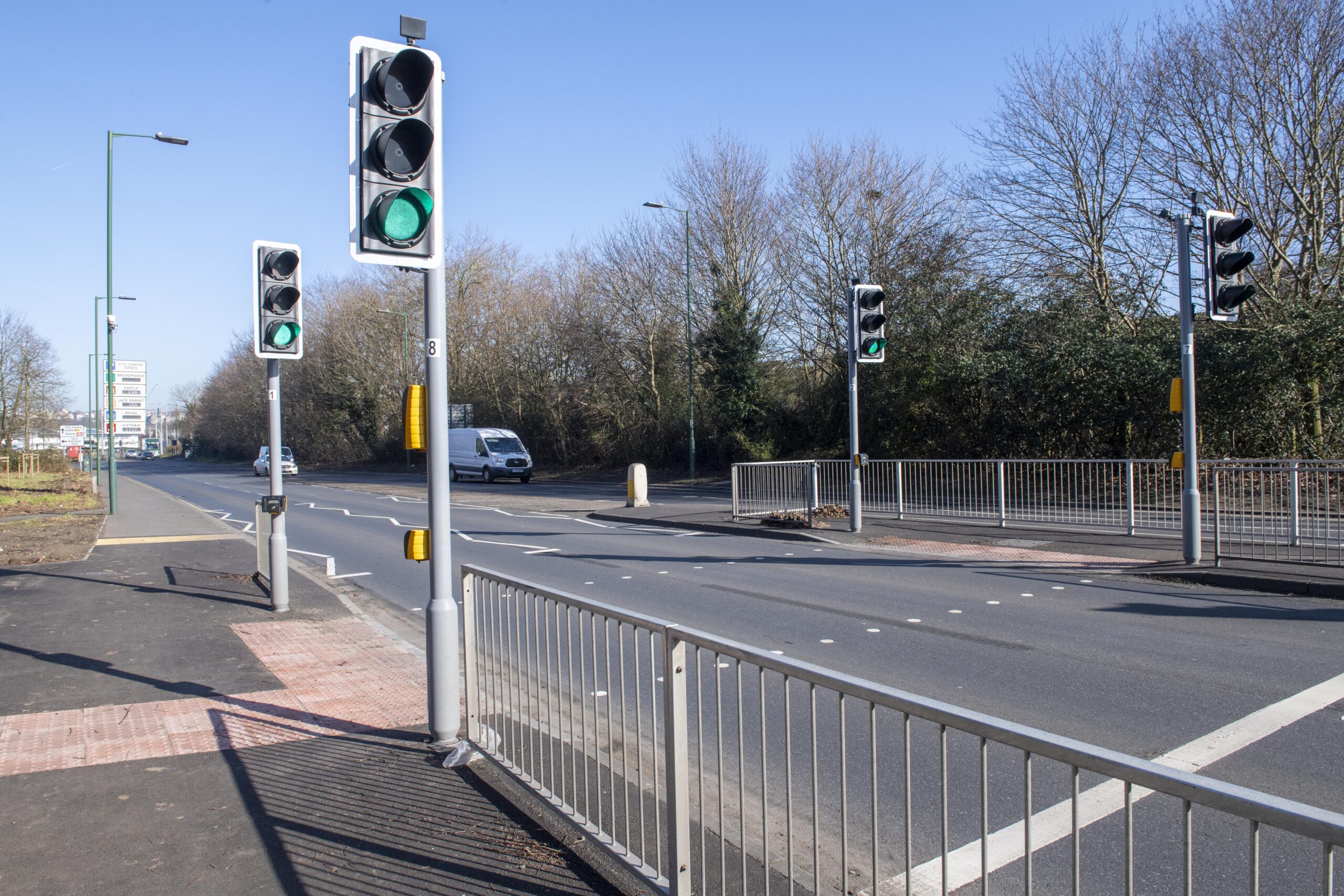
Recent grant funding has enabled more upgrades to traffic signal infrastructure across Nottingham than originally anticipated. As a result, the council is requesting an additional £4.5 million to continue maintaining and improving the network, bringing the total estimated investment to £9.5 million.
More of Nottingham’s traffic signals are set to be improved with LED and Extra Low Voltage (ELV) equipment, including two junctions and four pedestrian crossings. The council are also introducing adaptive traffic signal control at both junctions to improve efficiency. This will reduce waiting times and lower carbon emissions, as vehicles will spend less time idling under the new system.
As part of the work so far, the council has upgraded Nottingham’s traffic signals to energy efficient LED lights, replacing older halogen lamps, with £631,000 in funding from the Government’s Department for Transport. The council used this funding to boost reliability and reduce faults to provide a safer experience for motorists as well as longer-term maintenance savings. Across all areas of the city, 100 sites have been kitted out with new equipment to date. Approximately 95% of the council’s pedestrian lamps are LED compared to the national average of 88%.
The main advantages of LEDs over halogen lamps are that they generate the same light output with considerably less energy usage. The council’s traffic signals’ carbon emissions are down 19.1% on this time last year. Halogen lamps last for approximately 1000 – 2000 hours, whereas LED lamps have a much longer lifespan and can last up to 80,000 hours, which is a significant upgrade. Due to the LEDs’ longer lifespans, there has been a significant reduction in lamp failures, helping ensure clarity for motorists approaching signals. Replacing the lights with LEDs has provided cost savings due to the reduced energy required. The council’s energy usage is down from 140,000 kWh in March 2025 to 115,000 kWh at the end of March 2026.
Councillor Linda Woodings, Executive Member for Regional Development, Growth and Transport at Nottingham City Council, said: “Ensuring our traffic lights and infrastructure are upgraded and working well will help keep our city moving and make Nottingham’s roads safer for everyone. These improvements will also have a positive impact on our environment and local air quality, reducing congestion and requiring less energy to operate.”